
160, NOT OUT
26th March 2026
Zenith marks its 160 year anniversary milestone with a trio of chronographs that, between them, tell its rich history. Words by Laura McCreddie-Doak.
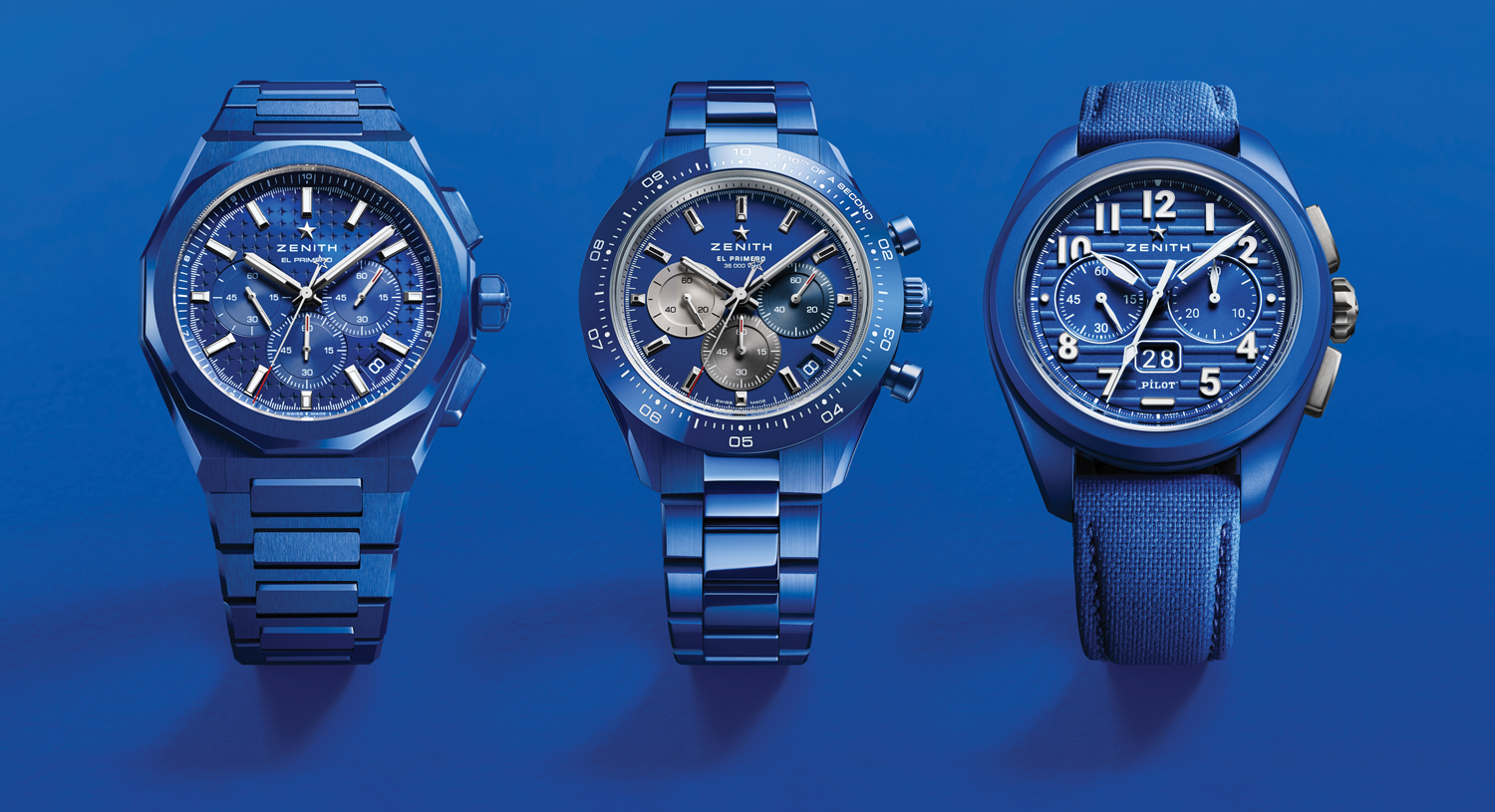
Precision, pilots, chronographs, Charles Vermot hiding the tools and the plans for the El Primero movement in the attic at Le Locle. There are many ways to tell the Zenith story but maybe it is worth looking at the story Zenith is trying to tell about itself through the watches it has chosen to celebrate its 160th anniversary. The G.F.J is the star of the show with its platinum case and resurrected Calibre 135. This movement was produced between 1949 to 1962 in two distinct versions: a commercial variant, and an “O” iteration made solely for observatory chronometry competitions. The Calibre 135-O received over 230 chronometry prizes, an absolute record in the history of watchmaking. That tells part of Zenith story, however it has also selected a trio of chronographs in Zenith blue. A trio that has obviously been chosen for what it represents in terms of the brand’s rich history from accompanying aviators to setting accuracy records.
NEW ADVENTURES IN AVIATON
PILOT BIG DATE FLYBACK
Cartier may have the accolade of creating the first pilot watch for Albert Santos-Dumont in 1904 but Georges Favre-Jacot saw the potential in pilot-ry back in 1888. There is a reason no other brand is allowed to put the word “pilote” or its English equivalent “pilot” on its watches and that is because, in 1888 and 1904 respectively, Favre-Jacot patented both of them. Louis Bleriot was Zenith’s equivalent to Santos-Dumont. A French aviator, inventor, and engineer. He developed the first practical headlamp for cars and established a profitable business manufacturing them, using much of the money he made to finance his attempts to build a successful aircraft, which he flew with a Zenith on his wrist across the English Channel in 1909 – the first person to attempt this feat. Despite Favre-Jacot’s obvious passion for aviation, “pilot” didn’t appear on a watch until 1957; even then it was a dress style rather than one with a chunky bezel and onion crown. It also disappeared very soon after. From 1968-1972 it resurfaced on watches for the Italian Airforce before coming to land in 2012 when Zenith unveiled its first real pilot’s watch – the Pilot Montre D’Aéronaut Type 20. It was limited to 250 and had a case that was a wrist-drowning 57.5mm. In another nod to Zenith’s history, it was powered by the hand-wound calibre 5011k, which was designed for a pocket watch and which set a record for accuracy at Neûchatel Observatory in 1967; just one of the 1,565 timepieces that won awards for accuracy since Zenith started submitting its movements for testing in 1896. From 2012 on the Pilot has stayed in the collection, even getting an El Primero at one point. 2023’s redesign toned down the hypermasculinity and for the 160th it comes with that aviation essential – the flyback chronograph. An addition that improves accuracy, something essential for a making cockpit calculations. And it has “pilot” on the dial, naturally.
Despite Favre-Jacot’s obvious passion for aviation, “pilot” didn’t appear on a watch until 1957; even then it was a dress style rather than one with a chunky bezel and onion crown
THE CONSTANT COMPANION
DEFY SKYLINE CHRONOGRAPH
The first watch to have the Defy name, or rather Defi as it was then, was a pocket watch from 1902. However, it was this original’s robustness that was to define future timepiece with the same name. The modern Defy comes from 1969, the same year as the El Primero, Zenith’s high-frequency, self-winding chronograph capable of measuring to 1/10th of a second. It was an integrated bracelet steel sports watch with a 14-sided bezel and muscular case, which earned it the nickname “bank vault” or “coffre fort” in French. Before you shout “Royal Oak” this was in 1969, three years before Audemars Piguet and seven years before Patek Philippe. As with most things in the world of Swiss watchmaking, quartz killed it off and it wasn’t until 2006 that Zenith decided to resurrect the Defy. This second chapter was more brash, this being during the Thierry Nataf era, one defined by oversized watches, flashy designs and crazy material combinations. For the Defy this meant precious metal cases, tourbillons and rather confused-looking dials bursting with complications. This era was quietly retired and the Chronomaster took over as the flagship design. Then in 2017, CEO Julien Tonare revived it as the king of high-frequency chronographs. Powered by the El Primero 21 Calibre 9004, it took the impressive 36,000vph and multiplied it by 10 making this the first watch to measure and display elapsed times to 1/100 of a second with a central chronograph hand that completed a revolution once a second rather than the standard once a minute. This set up the Defy as the watch to house Zenith’s timekeeping experiments, such as the 2019 Defy Lab, which had a wafer-thin silicon oscillator that served as a single-piece replacement for the sprung balance (balance wheel, balance spring, and lever). 2021’s Extreme added a tourbillon into the mix, while the Skyline, with its coloured graduated dials and smattering of diamonds brought some sartorial panache to proceedings. The Defy of 2025 is a symbol of Zenith continued exploration of accuracy.
The first watch to have the Defy name, or rather Defi as it was then, was a pocket watch from 1902
NEW KID ON THE BLOCK
CHRONOMASTER SPORT
Technically the Chronomaster is a new collection, however, it can trace its roots back to 1969 as the watch that housed the El Primero. Then known as the Ref.384, it had a panda dial, tonneau case and mushroom-style pushers. The watch though that had the most influence was the Ref. 386. This was the first to use the tricolour sub dials that was to become synonymous with the El Primero – an outward signal of what was under the dial, with blue for the minute counter at three o’clock, grey for the hours counter at six o’clock, and silver for the running seconds at nine o’clock. This iconic combination was resurrected in 2021’s Chronomaster Original and Chronomaster Revival A384. The modern origins of the Chronomaster start in 1994, and it was notable for a design feature that now seems standard among brands that take pride in their movements – the sapphire caseback. It was a signal that Zenith, following the quartz years, the nixing of El Primero by the US owners and Charles Vermot’s ingenuity in hiding the plans and tools, was back making mechanical chronographs and were proud to be doing so again. The Chronomaster Sport, first launched in 2021, also wears its mechanical prowess as a badge of honour. This is evident in the etched, graduated 1/10-second scale, which allows you to read the centrally mounted chronograph seconds hand, which completes a revolution every 10 seconds, against the bezel when stopped. Turn it over and you’ll see the El Primero 3600, which an enlarged blue column wheel so you can watch it in action when you deploy those pushers. It a fitting tribute to Zenith’s commitment to the chronograph.
Technically, the Chronomaster is a new collection, however, it can trace its roots back to 1969 as the watch that housed the El Primero. Then known as the Ref.384 it had a panda dial, tonneau case and mushroom-style pushers.
CONTINUE READING
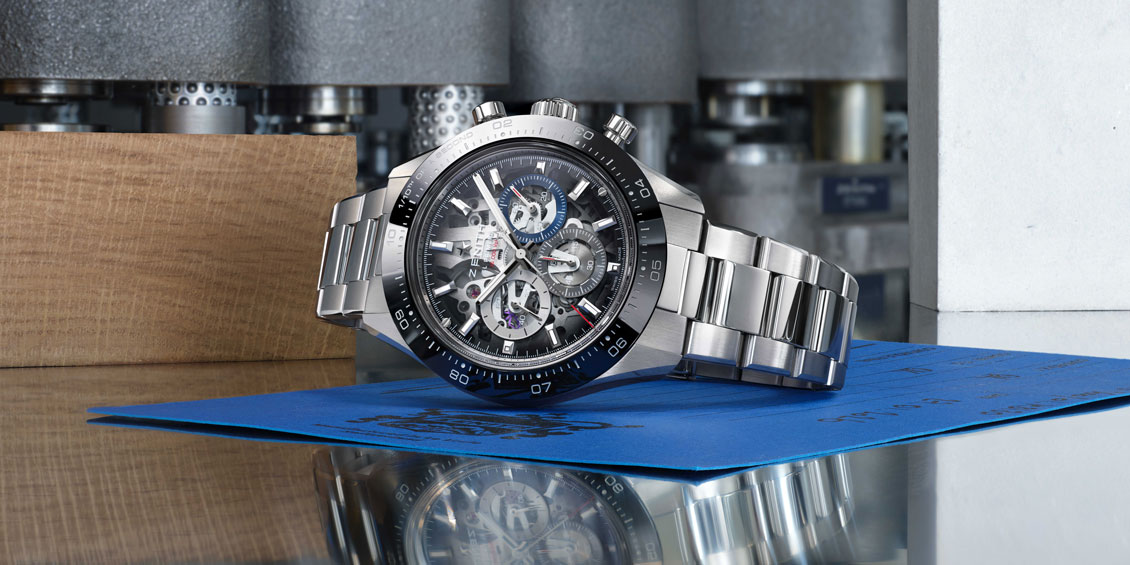
ZENITH AT ROX: SKELETONISED, SUPERCHARGED AND READY FOR THE SPOTLIGHT
ROX welcomed clients and collectors for an exclusive showcase of the latest novelties from Zenith, bringing together key releases from Watches & Wonders 2026 and LVMH Watch Week for a first look in Glasgow.
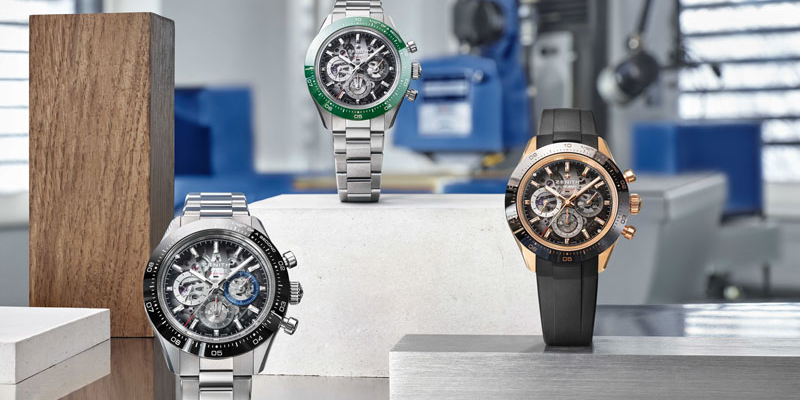
LUXURY WATCH EDIT
As the gendered codes of watch design ever-shift and overlap a merciful upshot is that overtly masculine brands or hero collections find themselves with licence to get more decorative
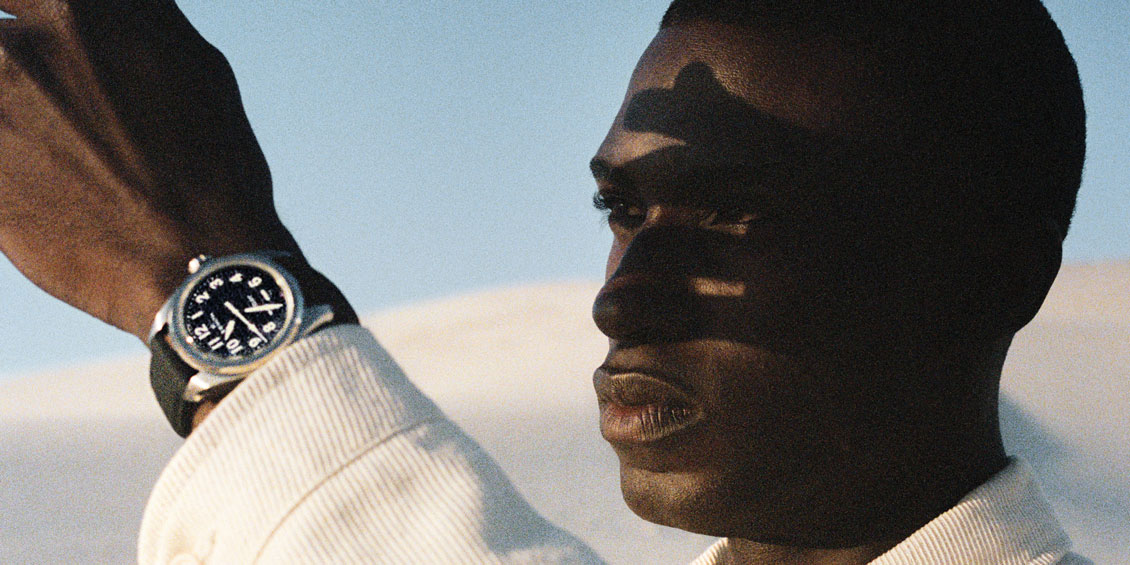
ZENITH HAS CONTROL
Captain of ‘Pilot’ as livery adorning any watch dial, Zenith has charted the skies since 1909 – continuing in magnificent fashion with an all-new fleet of flying machines.